


 Cart
Cart
 sales@molnova.com


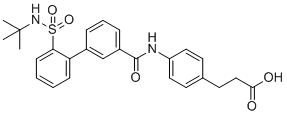
HIV-1 Integrase Inhibitor 1
CAS No. 2146094-22-4
HIV-1 Integrase Inhibitor 1( —— )
Catalog No. M13429 CAS No. 2146094-22-4
A novel compound that disrupts the HIV-1 integrase LEDGF interaction.
Purity : >98% (HPLC)
 COA
Datasheet
HNMR
HPLC
MSDS
Handing Instructions
COA
Datasheet
HNMR
HPLC
MSDS
Handing Instructions
| Size | Price / USD | Stock | Quantity |
| 100MG | Get Quote | Get Quote |


|
| 200MG | Get Quote | Get Quote |
|
| 500MG | Get Quote | Get Quote |
|
| 1G | Get Quote | Get Quote |
|
Biological Information
-
Product NameHIV-1 Integrase Inhibitor 1
-
NoteResearch use only, not for human use.
-
Brief DescriptionA novel compound that disrupts the HIV-1 integrase LEDGF interaction.
-
DescriptionA novel compound that disrupts the HIV-1 integrase LEDGF interaction; produces an ALLINI-like phenotype through engagement of IN sites distinct from the LEDGF pocket.
-
In Vitro——
-
In Vivo——
-
Synonyms——
-
PathwayMicrobiology/Virology
-
TargetHIV
-
RecptorHIV
-
Research Area——
-
Indication——
Chemical Information
-
CAS Number2146094-22-4
-
Formula Weight480.579
-
Molecular FormulaC26H28N2O5S
-
Purity>98% (HPLC)
-
Solubility——
-
SMILESCC(C)(C)NS(=O)(=O)C1=CC=CC=C1C2=CC(=CC=C2)C(=O)NC3=CC=C(C=C3)CCC(=O)O
-
Chemical Name3-(4-(2'-(N-(tert-butyl)sulfamoyl)-[1,1'-biphenyl]-3-carboxamido)phenyl)propanoic acid
Shipping & Storage Information
-
Storage(-20℃)
-
ShippingWith Ice Pack
-
Stability≥ 2 years
Reference
1. Burlein C, et al. ACS Chem Biol. 2017 Nov 17;12(11):2858-2865.
molnova catalog



related products
-
HIV-1 inhibitor-54
HIV-1 inhibitor-54 is a potent inhibitor of WT HIV-1 (strain IIIB) in MT-4 cells, demonstrating anti-HIV activity with an EC50 of 32 nM. [HIV-1 inhibitor-54 can be used to study viral infections.]
-
TAT
TAT (YGRKKRRQRRR) is derived from the transactivator of transcription (TAT) of human immunodeficiency virus-1 (HIV-1) and is a cell-penetrating peptide.
-
GS-9822
GS-9822 is a potent, non-catalytic site HIV integrase inhibitor with wild type EC50 of 3 nM.
